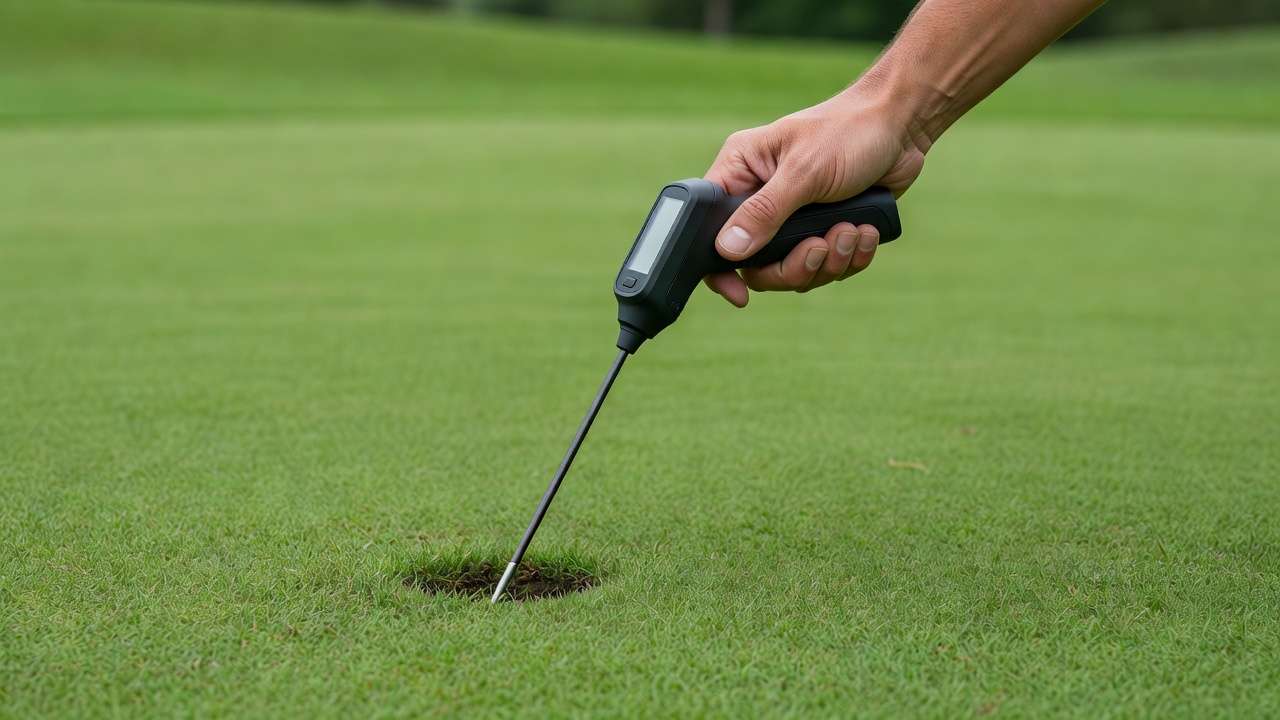
Moisture is local, not universal
Many turf moisture probes estimate volumetric water content from the electrical behaviour of the surrounding material. Volumetric water content describes water volume relative to the sampled bulk volume. It is not the same as a percentage of the water available to roots, and it should not be presented as a universal irrigation instruction. Texture, porosity, organic material and the instrument's calibration affect interpretation.
A reading from a sand-dominant rootzone cannot automatically be compared with the same number from a finer-textured soil. Even within one pitch, local repairs may behave differently. Establish a location-specific baseline under observed conditions, and keep the sensing depth attached to the result. An apparently dry upper layer and a wetter lower layer may both be accurate observations of different parts of the profile.
Gravimetric sampling can provide an independent reference when carried out correctly. Converting water mass to volumetric content requires appropriate bulk-density information; the two percentages are not interchangeable. ISO 11465 describes a gravimetric method for soil dry matter and water content. It is a laboratory-method reference, not an instruction to improvise an oven test in a stadium workshop.
Temperature provides context for change
Rootzone temperature helps explain seasonal growth and drying behaviour, but it is distinct from air temperature and leaf-surface temperature. Sensor depth, exposure and time of day matter. An infrared thermometer responds to the visible surface under its measurement conditions; a buried thermistor responds to its immediate surroundings. Comparing them without acknowledging that difference can produce a false impression of disagreement.
Combine temperature with weather and maintenance records rather than using it as an isolated trigger. A warmer rootzone may coincide with faster drying, but sunlight, wind, humidity, plant cover and irrigation also matter. Weather information from the Met Office can provide regional context; a venue's shading and ventilation can still produce a different local environment.
Conductivity is not a fertiliser prescription
Electrical conductivity indicates how readily a material conducts an electrical current under the instrument's test conditions. Water content, temperature and dissolved ions can all influence the response. Bulk electrical conductivity measured in place is not automatically equivalent to a laboratory extract result. Keep the reported unit, temperature compensation and method with the observation.
When conductivity changes, first ask whether moisture and temperature changed too. If salinity or nutrient availability is a concern, use a suitable sampling and laboratory interpretation process. A probe does not identify individual nutrients simply because it reports conductivity. Acting on that assumption can create unnecessary applications and obscure the original problem.
A compact measurement glossary
- Volumetric water content
- Estimated water volume per bulk sample volume, commonly expressed as a percentage or volume fraction.
- Rootzone temperature
- Temperature at the sensor's documented position and depth.
- Electrical conductivity
- An electrical response whose meaning depends on material, moisture, temperature and method.
- Surface hardness
- A method-specific response to impact, not a complete description of playability.
Physical response needs a defined method
Hardness, traction and infiltration describe different behaviours. A Clegg Impact Soil Tester records a response to a defined impact procedure. Hammer mass, drop sequence, location and surface condition affect interpretation. Results obtained through different protocols should not be combined into one unexplained series. ASTM F1702 addresses impact attenuation of natural playing-surface systems using a lightweight portable apparatus; confirm the current scope and applicable procedure before comparing results.
Traction testing explores resistance to movement under a specified device and loading method. It does not reproduce every player, stud pattern or movement. The FIFA Natural Playing Surfaces test framework and World Rugby natural-turf guidance provide sport-specific context, but the applicable requirements depend on the venue and competition. No single portable reading certifies all aspects of player safety.
Infiltration tests examine water entry under controlled conditions. Ring dimensions, insertion, initial moisture and applied head can change results. ASTM D3385 describes infiltration testing with a double-ring infiltrometer. A slow result may justify investigation, but it does not by itself distinguish surface sealing, a restrictive layer, blocked drainage or an unsuitable test setup.
Keep interpretation attached to evidence
For every measurement, record location, time, units, device, method and recent activity. Add weather, irrigation and visible symptoms where relevant. If a value appears unusual, label the uncertainty and repeat the check before explaining it as a biological or hydraulic change. The most useful record separates three statements: what the instrument reported, what the team observed and what the team currently thinks the cause might be.
All examples here describe interpretation principles rather than measured field data. Thresholds must come from an appropriate site baseline, competent advice and applicable requirements, not from copying a number out of an unrelated stadium's report.
Next: turn a trend into action