Begin with the operational question
A stadium surface contains several overlapping maps: the construction profile, the irrigation layout, the pattern of shade and the distribution of use. Start by asking what decision is currently difficult. Perhaps a shaded touchline remains wet, a warm-up area loses cover, or irrigation is being adjusted from observations at only one location. Each question suggests different monitoring points and different supporting inspections.
Walk the surface with the grounds team before drawing a network. Mark known repairs, drainage features, irrigation sectors, service routes and areas affected by temporary event flooring. Review construction records where available, but do not assume the current rootzone still matches the original specification. Repeated topdressing, local repairs and accumulated organic material can create important differences.
Choose contrasting and representative zones
Use a practical zoning scheme rather than a decorative grid. Include a representative reference area as well as suspected problem areas. A sensor installed only in the wettest location can reveal that location's behaviour, but it cannot establish whether the rest of the surface is drying normally. Pairing contrast with reference makes trends easier to interpret.
Illustrative planning schematic only. It does not prescribe sensor quantities, spacing or installation depth.
Where the profile changes, treat the boundary as a reason to investigate rather than averaging the difference away. A sand-dominant construction and a finer-textured repair may hold and release water differently. Similarly, a goalmouth can be a useful monitoring location without being a useful proxy for the centre of the pitch. Label what a location represents and what it does not.
Control depth, contact and disturbance
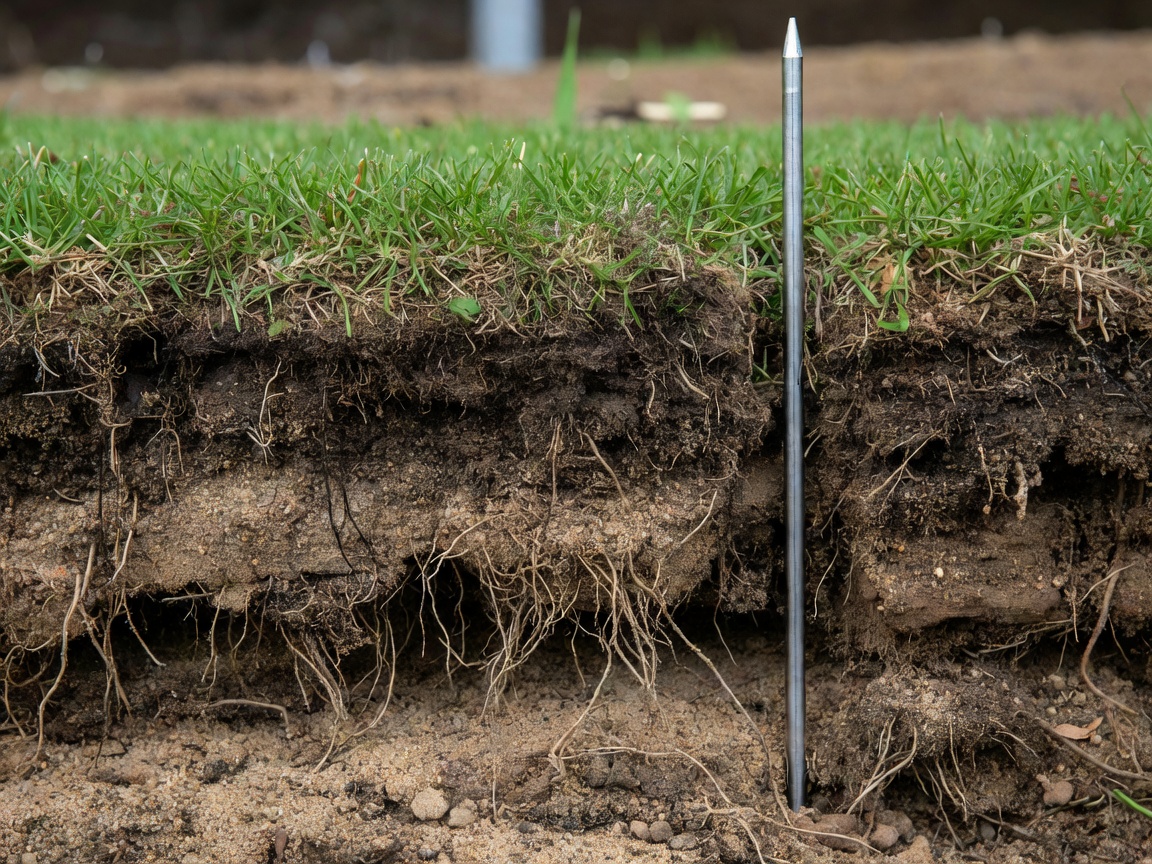
Choose installation depth according to the agronomic question, root distribution, construction and the instrument manufacturer's guidance. A shallow probe can respond rapidly to irrigation or surface drying; a deeper probe may describe another part of the profile. Results from different depths should not be merged as though they measured the same thing. Record depth with a clear reference, including whether it refers to the sensor centre or another defined point.
Good contact matters. Air gaps, loose backfill, stones and disturbed material can change a dielectric moisture sensor's response. Follow the installation procedure for the actual probe, protect cables and document any disturbed area. Photograph the installation before closing it. Coordinate with aeration, renovation and pitch-replacement plans so that buried equipment does not become a hidden obstruction or a recurring casualty.
Before excavation, locate services and obtain the venue's approval. Network convenience never overrides safe access or the need to protect the playing surface. Consider whether a wireless enclosure will be exposed to equipment, irrigation or temporary structures. The final location should remain recoverable through a site drawing and a stable reference system, not the memory of the installer.
Give mobile sampling a repeatable route
Fixed sensing provides continuity at selected points; portable testing adds spatial context. Establish a route with identifiable locations, a consistent order and a recorded test method. For measurements affected by recent irrigation or use, note timing as carefully as location. Repeat visits should be comparable enough that a difference is more likely to reflect the field than a changed sampling routine.
Portable instruments such as the Delta-T Devices WET-2, the Spectrum Technologies FieldScout TDR 350 and the Stevens HydraProbe use different designs and operating procedures. Their names are examples of real instruments, not endorsements or a claim that their outputs are interchangeable. Check each manual for sensing volume, installation constraints, calibration options and suitability for the material being tested.
Make the network understandable to the next person
Create a location register containing sensor identifier, coordinates or measured offsets, depth, installation date, rootzone description and intended purpose. Include a maintenance owner and the procedure for marking a sensor unavailable. Keep an annotated surface plan accessible to contractors before disruptive work. If a sensor is moved, give the new installation a distinct record rather than silently continuing the original series.
Organisations such as the Grounds Management Association and the Sports Turf Research Institute provide wider grounds-management context. The FIFA Quality Programme for Football Turf concerns artificial turf systems and associated testing; it should not be treated as a universal placement specification for natural grass. Confirm the scope of any reference before importing its requirements into a monitoring plan.
Placement handover test: could a colleague find the sensor, explain why it is there, identify its depth and repeat the supporting observation without calling the installer? If not, the network is not yet fully documented.
The next step is to establish what each measurement can legitimately tell you. A well-positioned sensor still needs the right units, a suitable method and a clear distinction between an observation and an inference.
Next: interpret the measurements